
How to Connect an OCuLink eGPU Dock to an ACEMAGIC Mini PC
Quick answer: OCuLink carries raw PCIe lanes over a cable, so a mini PC can drive a full-size desktop graphics card in an external dock. Setup is simple, with one rule you can't skip: on mini PCs, OCuLink is not hot-pluggable. Connect or disconnect the cable only with the PC and dock powered off.
| USB4 | OCuLink | |
|---|---|---|
| Bandwidth | 40 Gbps, shared | 64 Gbps, PCIe 4.0 x4 |
| Path | Tunneled | Direct PCIe |
Plug the monitor into the graphics card, not the mini PC. If the display cable runs back through the mini PC, the dock loses most of the gain.
Our own F5A 470 product page puts it plainly: "The OCuLink cable must be plugged/unplugged while the PC is turned off." Here's how to use OCuLink to add an eGPU to a mini PC: which ACEMAGIC models have the port, what to buy, the power-on order, and fixes when the GPU doesn't show up.

What Is OCuLink?
OCuLink (Optical-Copper Link) is a PCI-SIG standard for running PCIe outside the computer over a cable. It started out in servers and storage, but on mini PCs it's mostly used for one thing: an external GPU (eGPU).
Speed depends on how the port is wired: a PCIe 4.0 x4 link works out to 64 Gbps (16 GT/s across four lanes), a PCIe 3.0 x4 link to 32 Gbps. For pros and cons, see our OCuLink vs M.2 vs Thunderbolt eGPU interface guide. Not sure you need an eGPU? Read iGPU vs dGPU vs eGPU.
OCuLink vs USB4 and Thunderbolt: The Short Version
USB4 and Thunderbolt wrap PCIe inside another protocol. Thunderbolt 4 and USB4 carry about 32 Gbps of PCIe traffic, and Thunderbolt 5 and USB4 v2 up to 64 Gbps. Even so, OCuLink measured faster in independent testing (numbers below). The trade-off: OCuLink carries no power or display signal, and you can't hot-plug it. USB4 wins on convenience, OCuLink on speed. Full breakdown: OCuLink vs USB4 for eGPUs.
Which ACEMAGIC Mini PCs Have an OCuLink Port?
These current models have a built-in OCuLink port, according to their product pages:
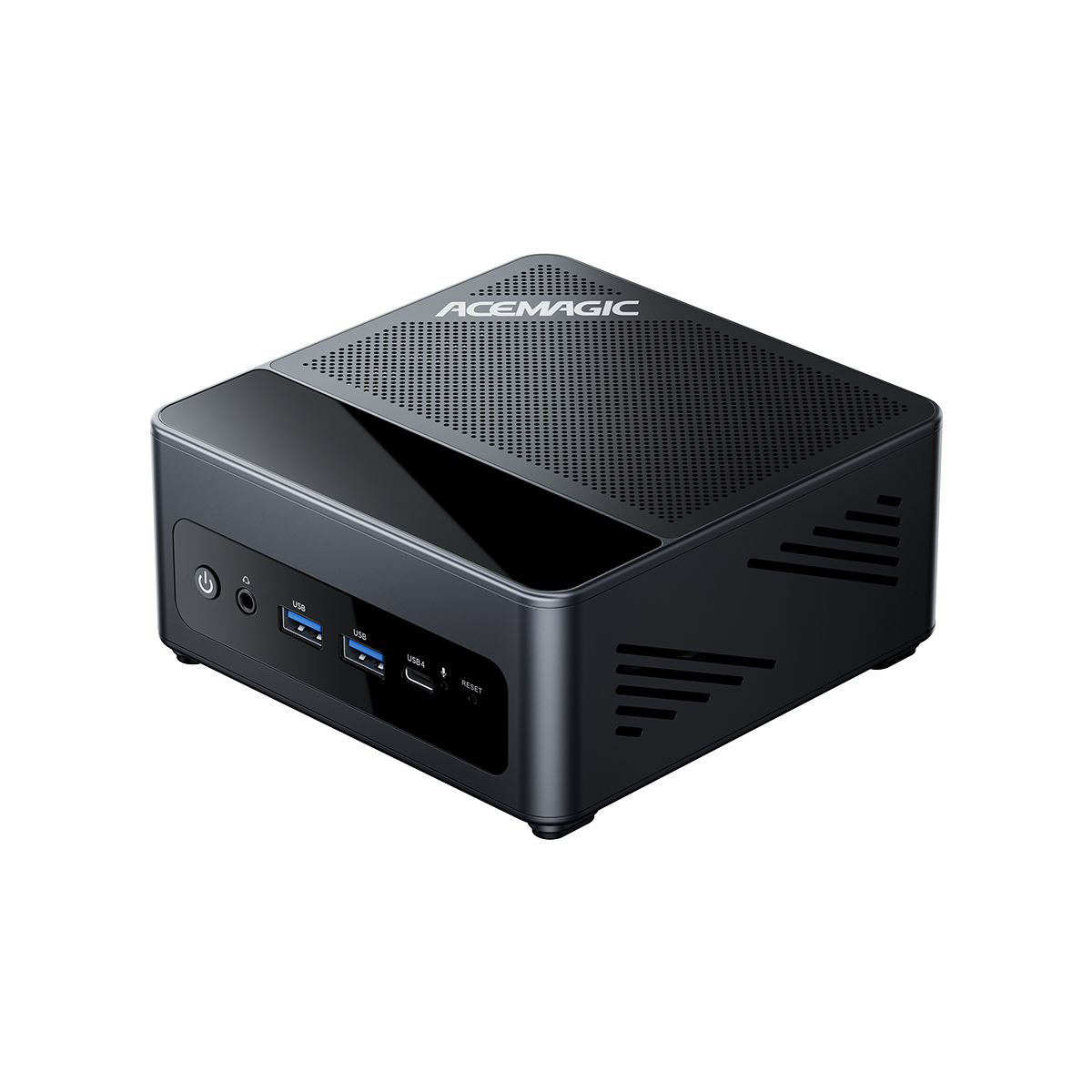
- ACEMAGIC AM18 (Ryzen 5 7640HS): one OCuLink port that "supports external dedicated graphics cards." More in our AM18 review.
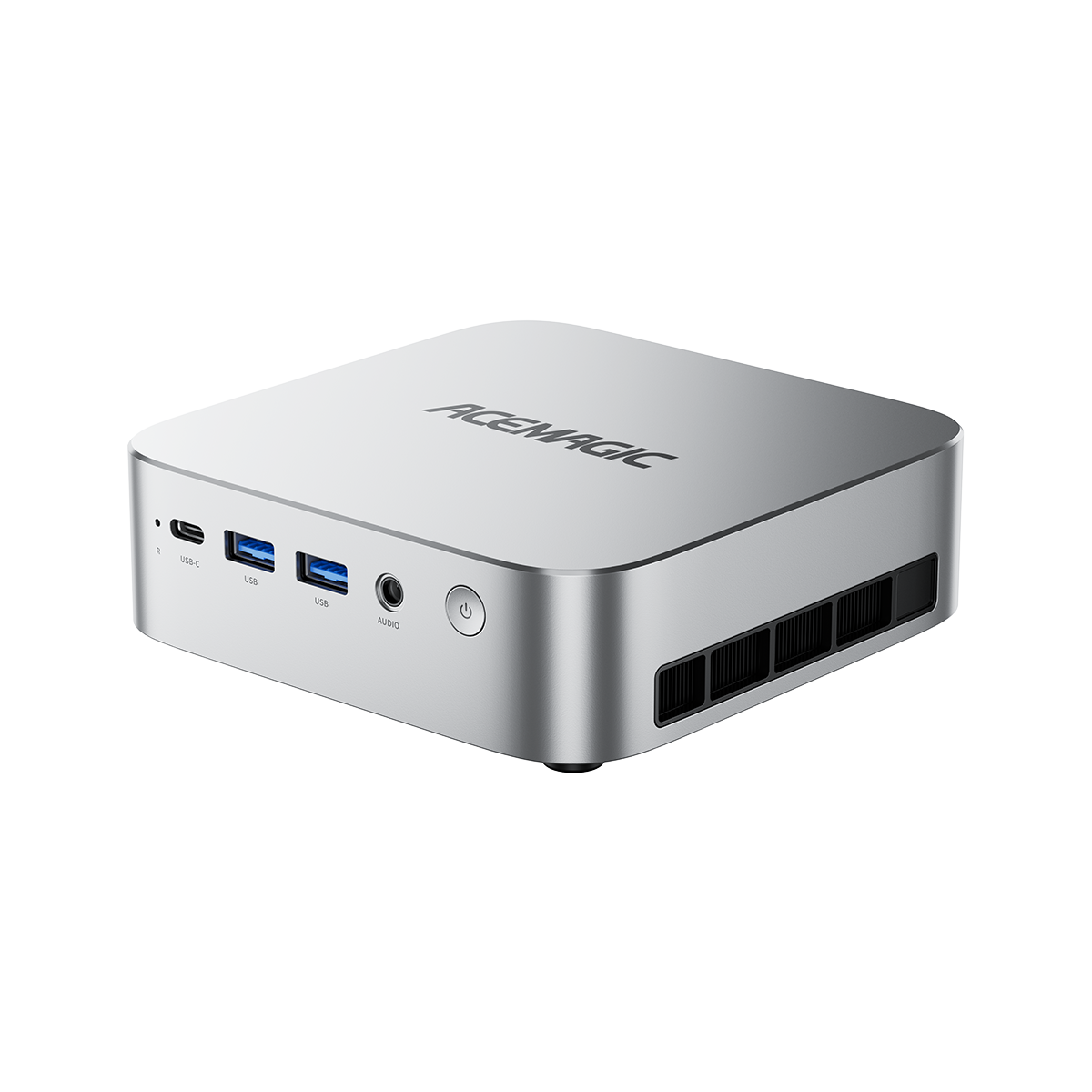
- ACEMAGIC F5A (Ryzen AI 9 HX 470): one OCuLink port that "supports external discrete graphics."
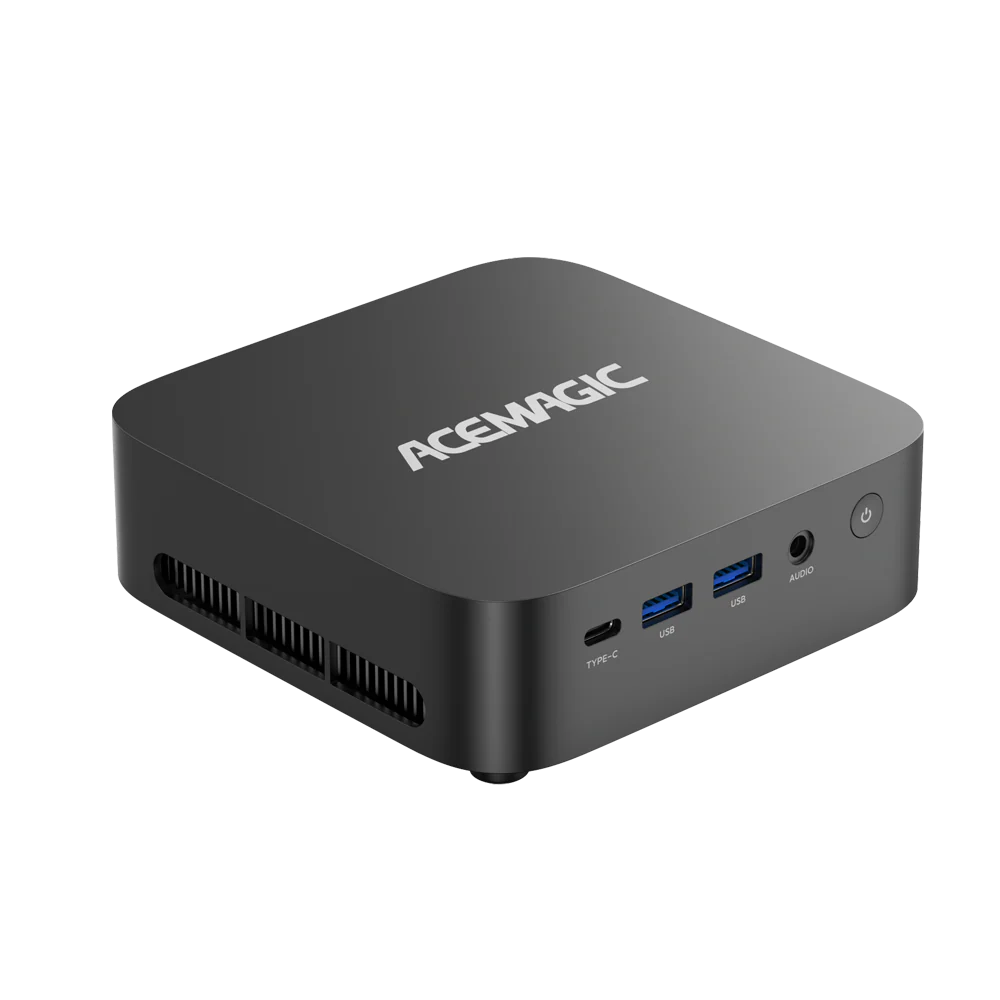
- ACEMAGIC F9A (Ryzen AI Max+ PRO 495): one OCuLink port rated at PCIe 4.0 x4.
The M1A PRO has no built-in OCuLink port; its product page notes the left side has space for M.2 adapters such as OCuLink (see the M.2 adapter FAQ below).
What You Need Before You Start
1. An OCuLink eGPU dock
The dock turns the OCuLink signal back into a regular PCIe x16 slot for your graphics card. You'll mostly see three styles:
- Open-frame, bring your own PSU: the Minisforum DEG1 takes ATX or SFX power supplies; the DEG2 adds Thunderbolt 5 and powers on automatically with the host.
- Built-in power supply: the AOOSTAR AG01 and AG02 have a built-in 800 W PSU; the AG02 adds USB4.
- GPU built in: the Minisforum MGA1 pairs a Radeon 7600M XT with OCuLink and a 240 W GaN power supply.
2. The right OCuLink cable
Plenty of guides mix up the connector names (the old version of this page did too). An OCuLink cable has SFF-8611 plugs on both ends. The ports on your mini PC and on the dock are SFF-8612 receptacles.
Use the cable that came with your dock if you can. Jeff Geerling found that look-alike OCuLink cables can be wired differently; swapping a generic cable for the DEG1's bundled one got his card working. And keep it short: OCuLink's signal degrades over distance, so a long cable is a stability risk.
3. A power supply sized for your GPU
OCuLink carries no power, so the dock's PSU feeds the graphics card, including slot power. Size it for the GPU, not a whole PC. Look up the card's total board power and the connectors it needs (8-pin or 12V-2x6). Sillectus' rule of thumb is at least 150 W above the card's total board power. The GPU maker's recommended system wattage is a conservative fallback. A fully modular PSU only makes cabling tidier; headroom and the right connectors are what count.
4. The graphics card and a monitor
Any normal desktop card can work if it fits the dock, but read the dock's compatibility notes (AOOSTAR, for example, lists the RX 9070 XT as not compatible with the AG01 and AG02). You'll also need a cable from your monitor to the card.
How to Connect an OCuLink eGPU Dock to Your Mini PC
- Update first. Install BIOS and Windows updates before the eGPU is involved, so you're troubleshooting one new device, not two unknowns.
- Assemble the dock. Seat the graphics card and secure its bracket so it can't rock (the DEG1's x16 slot doesn't lock). Connect the PSU to the dock (24-pin or the dock's specified connector) and the PCIe power cables to the card.
- Shut everything down. Fully shut down the mini PC (sleep isn't enough) and switch off the PSU.
- Connect the OCuLink cable at both ends. Make sure each plug is firmly seated in its port.
- Plug your monitor into the graphics card, not into the mini PC's HDMI or DisplayPort. Otherwise every frame travels back over the cable, costing bandwidth and frame rate.
- Power on in the right order. If your dock syncs with the host (the DEG2 does over OCuLink), just press the mini PC's power button. Otherwise, switch on the PSU and dock first, wait a few seconds for the GPU fans to spin, then start the mini PC. The PC scans for PCIe devices at boot; an unpowered GPU won't appear until the next restart.
- Install the GPU driver. Download the latest driver from NVIDIA or AMD (or Intel for Arc cards), install it, and reboot. Then confirm the card shows up in Device Manager.
- Check the BIOS only if you need to. If the card isn't detected, enter the BIOS and look for options to enable the OCuLink/PCIe port, set the primary display to the external GPU, and set link speed. Forcing PCIe Gen 3 is a handy test: if the card is stable at Gen 3 but not Gen 4, you have a signal problem, usually the cable or an adapter.

Troubleshooting Common OCuLink eGPU Problems
| Symptom | Likely cause | Fix |
|---|---|---|
| GPU not detected at all | GPU unpowered at boot, or cable connected while running | Shut down, power the dock first (or use power sync), then boot; check BIOS (step 8) |
| GPU detected, no picture | Monitor on the mini PC, or primary display set to the iGPU | Plug the monitor into the GPU; set primary display to the external GPU in BIOS |
| Random crashes, or the link runs at Gen 3 or x1 | Signal problems: long or mismatched cable, passive M.2 adapter | Use the dock's own short cable, avoid passive adapters, test at forced Gen 3 |
| NVIDIA card shows Code 43 in Windows | Driver conflict, often with another discrete GPU | Disable the other discrete GPU in Device Manager (if any); reinstall the NVIDIA driver |
| Black screen or dropouts after idle | PCIe power saving dropping the link | Windows Power Options: set PCI Express Link State Power Management to Off |
| Lower FPS than expected | Monitor plugged into the mini PC | Move the monitor cable to the GPU |
| Crash when unplugging | Hot-plugging | Always shut down first |
How Much Performance Do You Lose with an OCuLink eGPU?
Less than with Thunderbolt. Independent tester Try Some Tech, as reported by TechPowerUp, tested an RTX 5070 Ti on a Core Ultra 7 265K system:
- OCuLink: about 6.6 GB/s host to device, and roughly 7–8% slower in games than the same card in the motherboard slot.
- Thunderbolt 5: about 5.6 GB/s, and roughly 19–25% slower on average (worst cases near 36%).
That's one card on one desktop system, so treat it as a direction, not a promise. Your mini PC's CPU, link generation and lanes, and the game all matter.
How to Safely Disconnect Your eGPU
- Save your work and shut Windows down completely.
- Switch off the dock and its power supply.
- Unplug the OCuLink cable. Some docks, like the AOOSTAR AG01, have a locking port, so press the release before you pull.
- Move the monitor cable back to the mini PC before using it on its own.
OCuLink eGPU FAQ
Is OCuLink hot-swappable?
Not on mini PCs. ACEMAGIC, Minisforum, and AOOSTAR all say to power off before connecting or disconnecting, and unplugging live will usually crash the system. The one narrow exception: AOOSTAR says the AG01 can be hot-plugged on the TGX port of 2024 Lenovo ThinkBook 14+/16+ laptops.
What is an OCuLink port used for?
On a mini PC, almost always an external graphics card. Other PCIe devices are possible, but ServeTheHome found the DEG1 worked well with GPUs, not with the network and storage cards it tried.
Is OCuLink better than USB4 for an eGPU?
For performance, yes. USB4 wins on convenience: hot-plugging, plus power and display over one cable. Our OCuLink vs USB4 comparison goes deeper.
Can I use an OCuLink to M.2 adapter?
Yes, an M.2-to-OCuLink adapter in a spare SSD slot is a common way to add the port. The catch is signal quality: most are passive pin-to-pin boards that degrade the PCIe link, and Jeff Geerling found an adapter with a built-in ReDriver fixed cards that weren't detected. A built-in port avoids the issue.
Which ACEMAGIC mini PCs support an OCuLink eGPU?
The AM18, F5A (HX 470), and F9A (PRO 495) have a built-in OCuLink port; the M1A PRO has room for an M.2 adapter instead. For other models, check the spec sheet before buying a dock.
Can I connect an OCuLink dock to a laptop?
Only if it has an OCuLink port, and very few laptops do. With USB4 or Thunderbolt instead, a dual-mode dock like the AOOSTAR AG02 (OCuLink + USB4) or Minisforum DEG2 (OCuLink + Thunderbolt 5) works over that port, with the trade-offs above.
Final Thoughts
An OCuLink eGPU dock is a practical way to give a mini PC desktop graphics for gaming, creative work, or local AI. Use a short, known-good cable, power the GPU before (or with) the PC, plug the monitor into the card, and never hot-plug. Shopping for a mini PC with OCuLink? The F5A, AM18, and F9A all have the port built in.